

Hot Dipped Galvanized Elliptical Finned Tubes for Economizers & Evaporators
What Makes Hot Dipped Galvanized Elliptical Finned Tubes Effective for Economizers and Evaporators?
When selecting heat exchanger components for power plants, waste heat recovery systems, or industrial boilers, engineers often ask: which finned tube geometry and coating offer the best balance between thermal performance, pressure drop, and corrosion resistance? The hot dipped galvanized elliptical finned tube has emerged as a practical answer, particularly in Finned Tube for Economizer and Finned Tube for Evaporator applications. This article explores how these tubes function, why they outperform conventional circular designs, and what factors influence their selection.
1. How Does an Elliptical Profile Improve Performance in a Finned Tube for Economizer?
The elliptical shape is not merely an aesthetic choice. Compared to round tubes, an elliptical finned tube presents a streamlined cross‑section to the gas flow. This reduces the wake region behind the tube, which directly lowers pressure drop across the heat exchanger bundle. For an economizer — where flue gas passes over the tubes to preheat feedwater — a lower pressure drop means less fan power is required, cutting operational costs.
Additionally, the elliptical geometry increases the effective heat transfer surface per unit frontal area. Tests have shown that an elliptical finned tube can deliver 15–20% higher heat transfer coefficients than a circular tube of equivalent perimeter, while the air‑side pressure drop is typically 30–40% lower. This makes it especially attractive for retrofit projects where existing fan capacity is limited.
What about fouling and cleaning?
Elliptical tubes have a smoother flow pattern that reduces particle impingement and ash deposition. This is critical for economizers burning solid fuels. The hot‑dip galvanized coating also provides a smoother surface, making soot blowing more effective.
Which thermal design parameters matter most?
Key factors include fin pitch, fin height, tube wall thickness, and the arrangement (staggered vs. inline). Staggered layouts enhance turbulence and heat transfer, while inline layouts reduce pressure drop — a trade‑off that must be evaluated case by case.
To quantify the advantages, the following table summarises the key performance differences between elliptical and conventional circular finned tubes under similar operating conditions.
| Performance Metric | Elliptical Finned Tube | Circular Finned Tube | Typical Improvement |
|---|---|---|---|
| Heat transfer coefficient | Higher | Baseline | ↑ 15–20% |
| Air‑side pressure drop | Lower | Standard | ↓ 30–40% |
| Fouling tendency | Reduced (smooth flow) | Moderate | Enhanced cleanability |
| Corrosion protection (zinc coating) | ≥0.06 mm alloy layer | Varies | Superior for acidic environments |
2. Which Coating and Material Choices Suit a Finned Tube for Evaporator?
In evaporator sections, the finned tube is exposed to a mix of high‑temperature flue gas and water/steam mixture. Corrosion from acidic condensates and stress from thermal cycling are major concerns. The hot‑dip galvanized layer (zinc‑iron alloy) provides cathodic protection: even if the coating is scratched, the zinc sacrifices itself to protect the steel base. This is particularly beneficial when the evaporator operates with low‑grade fuels or in waste‑to‑energy plants.
For moderate temperatures (up to 350–380°C), hot‑dip galvanized elliptical finned tubes offer a cost‑effective balance. However, when operating temperatures exceed 400°C, the galvanized coating may degrade due to zinc diffusion or melting; in such cases, aluminized or stainless steel fins are recommended. Always verify the acid dew point of the flue gas — if the tube surface drops below that point, the galvanized coating’s resistance to sulfuric acid corrosion becomes a decisive advantage.
Practical tip: For evaporator service, evaluate both peak metal temperature and the flue gas dew point to select the appropriate coating thickness and material.
3. Finned Tube for Economizer vs. Finned Tube for Evaporator – How Do They Differ?
Although both use similar finned tube technology, the design priorities differ. An economizer typically operates with lower heat flux and higher gas velocities, so the emphasis is on maximizing heat recovery with minimal pressure drop. An evaporator, on the other hand, handles boiling heat transfer, which is more sensitive to surface temperature uniformity and nucleate boiling promotion.
| Characteristic | Economizer Application | Evaporator Application |
|---|---|---|
| Primary function | Preheat feedwater | Generate steam |
| Heat flux | Moderate (10–30 kW/m²) | Higher (30–60 kW/m²) |
| Flue gas temp. range | 300–500°C | 600–900°C (inlet) |
| Coating priority | Corrosion from low‑temp acid | Oxidation & high‑temp creep |
| Typical fin pitch | 6–12 mm | 10–20 mm (to reduce fouling) |
| Arrangement | Staggered (for compactness) | Inline (for cleaning access) |
This table illustrates that while the same basic tube can be used, the configuration must be tailored to the specific duty. For instance, Finned Tube for Economizer often employs tighter fin spacing and a staggered layout to maximize heat transfer within a limited volume, whereas a Finned Tube for Evaporator may use wider spacing to accommodate steam blanketing and reduce the risk of dry‑out.
4. Manufacturing Process & Quality Control
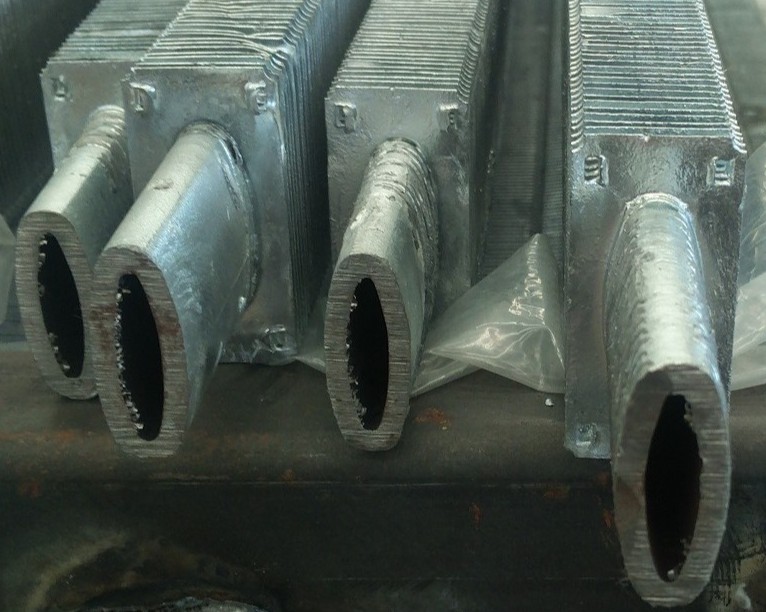
The production of hot‑dipped galvanized elliptical finned tubes involves several controlled stages:
- Tube forming: Carbon steel tubes are cold‑drawn or rolled into an elliptical shape with precise dimensions (commonly 25×38 mm or 30×45 mm).
- Fin attachment: Fins (usually carbon steel or stainless steel) are helically wound or serrated onto the tube and secured via high‑frequency resistance welding — ensuring a metallurgical bond with minimal contact thermal resistance.
- Hot‑dip galvanizing: The assembled tube is degreased, pickled, fluxed, and dipped into a molten zinc bath (≈450°C). The resulting coating comprises a sequence of zinc‑iron alloy layers (zeta, delta, gamma) topped by a pure zinc outer layer. Typical coating weight is ≥ 600 g/m² (equivalent to ~85 µm thickness).
- Inspection: Each tube undergoes visual inspection, coating thickness measurement (magnetic gauge), and adhesion tests (bend or hammer tests) per ASTM A123 and EN 1461.
These steps ensure that the final product meets the stringent requirements of both economizer and evaporator services, where reliability is paramount.
Which quality standards apply?
Common specifications include ASME Section VIII (for pressure parts), ASTM A179/A192 for tube material, and ASTM A123 for galvanized coatings. Many suppliers also offer third‑party inspection.
How does fin density affect performance?
Higher fin density (more fins per meter) increases surface area but also raises pressure drop and fouling risk. A fin density of 100–150 fins per meter is typical for economizers.
What about thermal expansion?
Elliptical tubes accommodate differential expansion better than flat plates. However, proper support and clamping are necessary to prevent stress fatigue in evaporator sections.
5. By Flue Gas & Working Fluid Flow Direction Considerations
The orientation and arrangement of elliptical finned tubes relative to flue gas and working fluid flow significantly influence overall heat exchanger performance. Key considerations include:
- Cross‑Flow Arrangements: Elliptical tubes in staggered configurations optimize heat transfer while minimizing pressure drop, making them ideal for air‑cooled heat exchangers.
- Counter‑Flow Designs: In economizer applications, arranging tubes to achieve counter‑current flow between flue gas and feedwater maximizes thermal recovery.
- Flow Velocity & Fouling: The streamlined elliptical profile reduces particle impingement and fouling, particularly beneficial in high‑velocity gas streams.
6. Technical Specifications & Customization
Hot dipped galvanized elliptical finned tubes are available in a wide range of configurations to meet specific project requirements.
| Parameter | Typical Range | Notes |
|---|---|---|
| Tube Outer Diameter (Elliptical) | 25–38 mm | Custom sizes available |
| Fin Material | Carbon steel, stainless steel, alloy steel | Matched to application |
| Fin Pitch | 5–20 mm | Customizable |
| Maximum Operating Temperature | Up to 400°C (galvanized) | Above 400°C consider alternative coatings |
| Zinc Coating Thickness | ≥0.06 mm (per ASTM A123) | Typical 85 µm for heavy-duty service |
7. How to Select the Right Tube for Your Heat Recovery System?
Selection involves evaluating the operating conditions (temperature, pressure, gas composition), space constraints, and maintenance strategy. Here are some practical guidelines:
- For economizers with low‑sulphur fuels: Hot‑dipped galvanized elliptical tubes are an excellent choice due to their resistance to mild acidic conditions and their high thermal efficiency.
- For evaporators in waste‑to‑energy plants: Consider a thicker galvanized coating (≥100 µm) or a duplex coating (zinc + epoxy topcoat) to handle the aggressive environment.
- If pressure drop is a critical constraint: Choose a larger elliptical aspect ratio (e.g., 2:1) and wider fin pitch to further reduce flow resistance.
- If space is limited: A staggered arrangement with tighter fin spacing maximizes the heat transfer per unit volume — ideal for retrofitting older boilers.
It is also worth noting that Heat Recovery Steam Generators frequently employ elliptical finned tubes in both economizer and evaporator sections, capitalising on the shape’s combined benefits. Similarly, Cast Iron Economizer and H-Fin Tube Economizer designs often incorporate elliptical variants, while Studded Pipe Economizer solutions may also benefit from the elliptical form factor.
8. What Maintenance Practices Extend the Life of These Tubes?
Even with a robust galvanized coating, regular inspection and maintenance are essential. Key practices include:
- Visual inspection: Check for white rust (zinc oxide) or red rust (steel corrosion) — early signs indicate coating damage.
- Deposit removal: Use soot blowers or manual brushing to prevent ash accumulation, which can insulate the tube and reduce heat transfer.
- Coating repair: For small localized damages, apply zinc‑rich repair paint or cold‑galvanizing compounds to restore cathodic protection.
- Thermal monitoring: Track tube metal temperatures; a sudden rise may indicate fouling or internal scaling, requiring chemical cleaning.
When properly maintained, hot‑dipped galvanized elliptical finned tubes can achieve a service life of 15–20 years in typical power plant environments, making them a durable and cost‑effective solution.
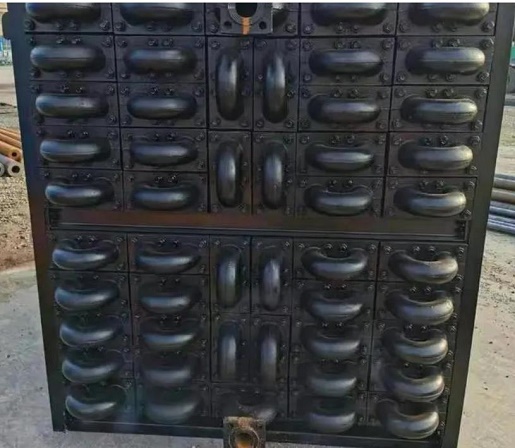
Selecting the right finned tube ultimately depends on the specific thermal duty, flue gas composition, and maintenance regime. For economizer service, tighter fin pitches and staggered layouts maximize recovery; for evaporators, wider spacing and inline arrangements improve steam release and cleaning access. The galvanized elliptical finned tube consistently demonstrates lower pressure drop and higher heat transfer over circular alternatives, and its corrosion resistance has been proven in thousands of operating units worldwide. When specifying, always cross‑check the operating temperature window against the coating limits and account for the acid dew point to avoid premature failure.